
Are you a beginner in Patagonia? I regularly receive similar messages quite frequently: “Andrés, I’ve never fly fished before. Should I start in Patagonia or wait and learn somewhere else first?”
My answer is always the same: start in Patagonia.
I know that sounds strange. Patagonia has a reputation for being demanding — clear water, educated fish, relentless wind. And part of that reputation is earned. But there’s something that rarely gets mentioned: when the river is demanding, guides learn to be better too. There’s no room for shortcuts here. And that, paradoxically, makes the teaching better.
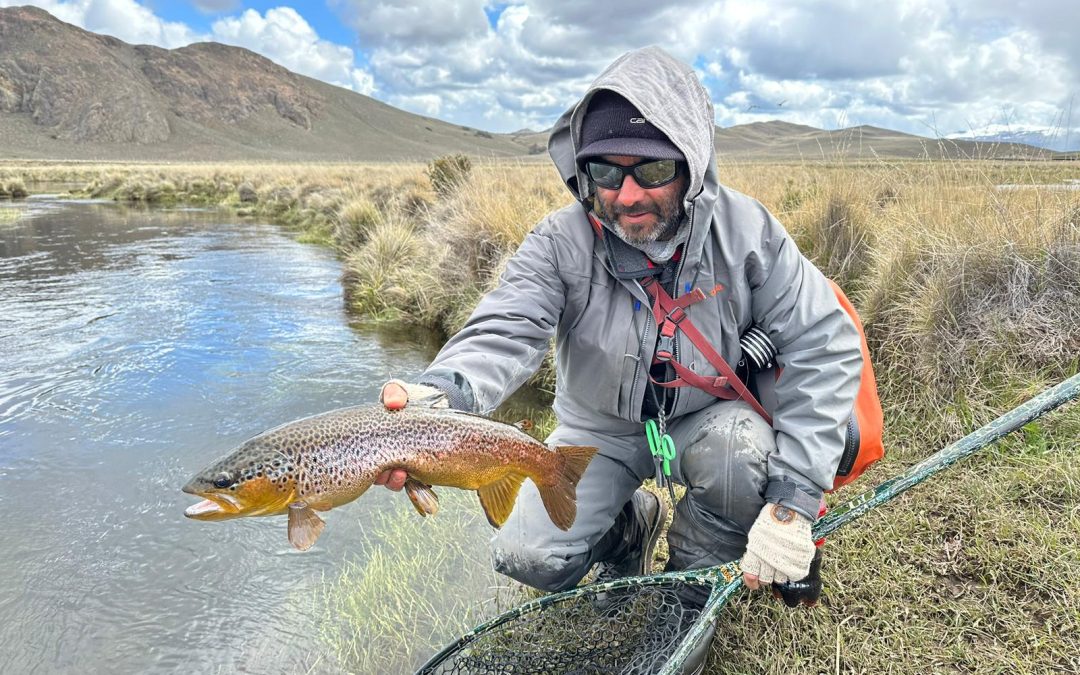
I’ve had clients arrive at 65 years old having never cast a fly in their lives, and leave catching 20-inch trout. Not because they were natural talents. Because we put them in the right place, gave them room to make mistakes, and the river did most of the work.
One I remember in particular is Robert, a 58-year-old lawyer from Chicago who arrived completely convinced he was going to be a disaster. On the second day, standing in the Ñirehuao River with water up to his knees, he landed a 19-inch trout on his second clean cast. The look on his face in that moment — that’s what makes this job feel like anything but work.
BEGINNER IN PATAGONIA – HONEST GUIDE 2026
WHY PATAGONIA CAN ACTUALLY BE A GREAT PLACE TO START
- Clear water — you see exactly what’s happening
In murky rivers you learn to cast, wait, and hope. In Patagonia you see the fish before it eats your fly. You watch how it moves, when it’s interested, when it isn’t. That real-time feedback accelerates learning in a way that’s genuinely hard to replicate anywhere else.
- Not every fish is impossible
The most damaging myth out there is this: “Patagonia is difficult water.” It’s partly true. There are technical sections and very selective fish. But in smaller rivers, in lakes, in quiet riffles, there are trout that don’t demand a perfect presentation. Our job as guides is to start there — where the fish are receptive. Technique comes later. Confidence comes first.
- Enough action to keep you hooked
A beginner who casts imperfectly but is in the right spot — is going to catch fish. And the first time a trout rises to eat your fly, something shifts. It’s hard to put into words, but everyone who’s experienced it knows exactly what I mean.
We’d rather not put anyone through three days without a single take. That kills motivation before it ever gets started. With good planning, that’s almost always avoidable.
WHAT TO EXPECT ON YOUR FIRST DAY: NO FILTERS
8:30 AM — We pick you up at the hotel.
9:30 AM — We arrive at the river. You’ll probably think: “Are there actually fish in here?” There are.
9:30 – 11:00 AM — Casting lesson on the water. We work through:
How to hold the rod properly
- The fundamentals of the cast (backcast, forward cast, timing, loading the rod)
- How to read what the line is telling you
- Your first mends
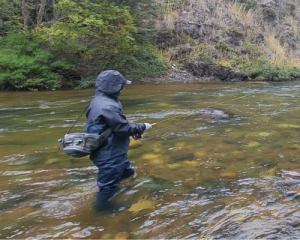
It’s not as complicated as it looks. It’s mechanics. With a couple of hours of practice, most people are casting 30–40 feet with reasonable fluidity.
1:00 PM — Streamside lunch. Good food, Chilean wine if you want, and time to ask everything that built up during the morning.
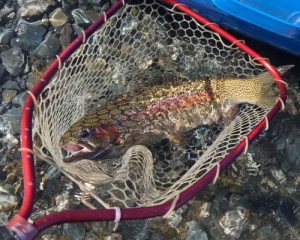
2:00 – 5:30 PM — Real fishing. You apply what you learned. The guide puts you where the fish are. You cast. You’ll probably lose a few, maybe land two or three. The cast noticeably improves during these hours in a way that surprises most people.
5:30 PM — Return. Tired, with something worth telling, and already thinking about tomorrow.
Honest reality check: on a good first day with reasonable conditions, 2 to 5 fish is a realistic expectation. Some small, one or two decent. Not the story the client tells when he gets home about catching twelve 20-inch trout — that’s usually selective memory, not reality.
WHAT TO EXPECT THROUGH YOUR FIRST WEEK
Day 3: You’re casting noticeably better. You feel more comfortable in the water. The first bigger fish start appearing — 18 to 20 inches — and with them, the feeling that this is starting to make sense.
Days 4–5: You’re handling terms like upstream cast, mend, and strip without thinking about them. Your technique has shape. The mistakes are more specific, which means you already understand what you’re correcting.
Day 6: Someone watching you from the bank would probably assume you’ve been doing this for a while. You know you haven’t, but the progress is real and visible.
WHAT YOU NEED TO BRING MENTALLY
- Patience. You’re not going to master this in three days. Casting takes practice. Reading water takes time. And that’s completely fine.
- Willingness to get things wrong. You’re going to cast short. You’re going to hook a tree on your backcast. You’re going to spook a fish. The tippet is going to break at the worst possible moment. All of that is part of the process — it’s not a sign that you’re not cut out for this, it’s exactly how it’s learned.
- Trust in your guide. If we suggest a specific spot, there’s a reason. If we ask for short strips, there’s a reason. You don’t need to understand everything in the moment — later, when you see it work, it’ll make sense on its own.
THE MOST COMMON MISTAKES — AND HOW TO AVOID THEM
- Casting with force. Nearly everyone does it at first. Fly casting is timing and precision, not muscle. The harder you throw, the worse it works. That instinct needs to be unlearned.
- Not waiting for the backcast. The most frequent mistake, by far. The line is still traveling backward and the forward cast is already launched. The result is a tangle in the air and a lot of frustration. The fix is simple but takes practice: listen to the line, feel when it has loaded.
- Overthinking. “Size 12 or 14? Mend now or wait?” Stop. Use the fly we gave you. Do what we agreed on. If it’s not working, we adjust together — that’s what we’re here for.
- Wanting the big fish on day one. Big fish require better presentation. That’s not there yet on the first day, and there’s nothing wrong with that. Start with mid-sized fish, build confidence, and the big ones come on their own when the moment is right.
THINGS THAT WILL SURPRISE YOU — IN A GOOD WAY
- Wind has a workaround. Patagonia has wind — that doesn’t change. But once you learn to position yourself and cast with it instead of against it, it stops being a problem and becomes part of the game.
- Every river is different. The Simpson doesn’t fish like the Blanco. The Blanco doesn’t fish like a lake at Cerro Castillo. Every body of water has its own logic, its own character, its own fish. That variety is a big part of what makes people want to come back.
- Fish follow patterns. It’s not magic or luck. It’s observation and logic. Certain conditions, certain locations. Learning to read that is one of the most satisfying things this sport has to offer.
- The physical tiredness is real. Fly fishing looks calm from the outside. It isn’t. After seven or eight hours of casting and wading, your body knows it. Arriving in reasonable shape makes a genuine difference.
SUGGESTED PROGRAM FOR A BEGINNER
The minimum we recommend is 4 days of fishing. Daily trips out of Coyhaique are a natural starting point.
Days 1–2: Casting fundamentals and fishing in calm, approachable water
Days 3–4: Applied technique in water with a bit more challenge
If you have more time, a full week changes the experience entirely. Somewhere around day 5 or 6, something tends to click — it’s hard to describe, but everyone who goes through it recognizes the moment when it happens.
TO WRAP UP
- We’ve been guiding and teaching beginners for a long time. And we’ve genuinely never — not once — seen someone who couldn’t learn.
- What we have noticed: the people who progress fastest aren’t the most athletic or the most technically minded. They’re the ones who arrive willing to listen and willing to fail without getting frustrated. Attitude is almost everything.
- The initial fear is completely normal. Everyone has it — even those who won’t admit it. The difference is whether you leave it in the car when you get to the river, or carry it with you all day. The ones who leave it in the car almost always catch fish.
- Come as a beginner. The river teaches. We help along the way. And a few days later, you’re already thinking about when you can come back.
READY TO TAKE THE FIRST STEP?
We offer programs built for beginners — instruction included, equipment available, and the time you need to learn without rushing.
Get in touch and we’ll find the program that fits your level and your dates.