
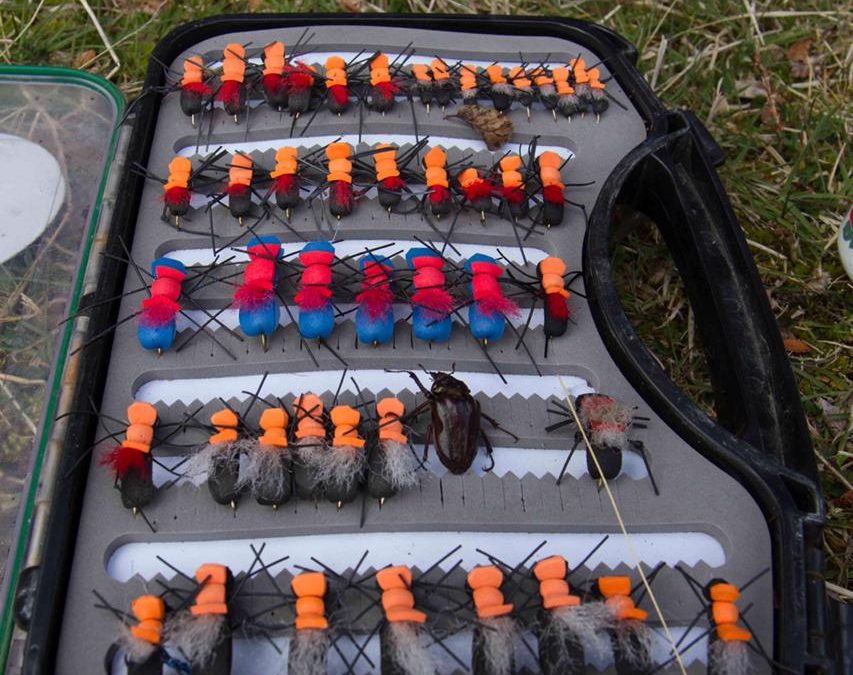
I get emails like this almost every week: “Andrés, what flies should I bring?” And while the honest answer is that it depends on the area, the season, and the conditions on any given day, we decided to do something more useful than a generic “it depends” — a list of the 12 patterns that consistently perform in the rivers and lakes we fish most.
Specific patterns shift year to year — that’s exactly our job as guides, reading the conditions and figuring out what’s working. But with this list, you can show up ready to fish with confidence. We always bring the specialty patterns for each outing, and if you want to dig deeper on any specific pattern or location, just ask us when planning your trip.
FISHING FLIES: THE 12 ESSENTIAL ONES
DRY FLIES
- Purple Haze
- Think Parachute Adams, but with a purple body. For reasons we still can’t fully explain, it often outperforms the original Adams. An absolute must in every box.
- Sizes: 12, 14, 16, 18
- Chubby Chernobyl
- A fantastic attractor pattern that works on its own or as an indicator with a dropper nymph. Our favorite is the Royal. Micro versions are deadly on smaller streams and wade fishing sections.
- Sizes: 8, 10, 12, 14 — Colors: Royal, Purple, Tan, Gold
- Swisher’s Dancing Caddis
- In our view, the most effective and versatile caddis pattern on the list. It can double as a small stonefly or hopper imitation — a true wildcard that always earns its spot in the box.
- Sizes: 12, 14, 16 — Colors: Tan, Olive, Peacock
- Fat Albert
- Created by our good friend Brent Taylor, and a proven favorite in our waters. It comes in many variations — the bright blue abdomen versions are particularly effective in black foam, and during hopper season, tan is king. The originals tied by MFC are worth tracking down.
- Sizes: 10, 12, 14 — Colors: Tan, Black
- Swisher’s Foam PMX
- In tan, it’s a top-notch hopper imitation. In black, it works beautifully on lakes as a beetle pattern. In smaller sizes it can save the day with selective trout — for that scenario, we recommend the cricket version.
- Sizes: 8, 10, 12 — Colors: Black, Tan
STREAMERS
- Kreelex
- Similar to a Clouser Minnow but tied entirely with rough flash material. Over the years it has proven to be an indispensable pattern — on some days it’s the only thing that works. Available in multiple color and weight combinations to help with casting.
- Sizes: 6, 8 — Colors: Gold/Copper, Silver/Copper, Purple/Silver
- Woolly Bugger
- A timeless classic that simply doesn’t fail. From traditional ties to modern variations like the Sparkle Minnow, there’s a version for every situation. Our personal picks lean toward black and peacock as the go-to colors. A special favorite of ours is the Thin Mint.
- Sizes: 6, 8 — Colors: Peacock, Black, White, Olive, Brown
- Muddy Buddy
- A Zonker with a cone head (usually silver) and more bulk than simpler patterns like the Slumpbuster. It’s the perfect choice when you want volume without going to a full articulated fly. Silver cones are our preference on overcast days.
- Sizes: 6, 8 — Colors: Olive, Brown, White, Black
NYMPHS — “THE UNDERRATED ONES”
- Pheasant Tail & Variations
- A fly fishing staple that belongs in every box. It excels at imitating mayfly nymphs across a range of stages. From the most natural ties to Flashback, jig hook, and hot spot versions — each has its moment.
- Sizes: 14, 16, 18
- Prince Nymph & Variations
- More attractor than imitator, it covers a broad range of insects and works consistently throughout the season. Modern variations with a hot spot collar are among our current favorites.
- Sizes: 12, 14, 16
- Copper John
- When you need a hard-hitting attractor nymph in slightly off-color water, this is our go-to — especially in red. A pattern that earns its place in any box heading to Patagonia.
- Sizes: 12, 14, 16 — Color: Red
- Girdle Bug
- Originally designed to imitate stoneflies, it shines as a searching nymph in both rivers and lakes. Its attractor qualities are remarkable — and it never fails to surprise anglers who discover it for the first time.
- Sizes: 8, 10 — Colors: Brown, Olive, Variegated
THE TRUTH ABOUT FISHING FLIES BOXES
You don’t need to haul half a fly shop to Patagonia. A couple of well-organized boxes is all it takes. Build your selection around the patterns on this list and you’ll have a proven, battle-tested foundation for these specific waters.
A realistic box for Patagonia:
- 3 dozen dry flies (Adams, Wulff, Hopper, Stimulator)
- 2 dozen streamers (Woolly Bugger, Articulated, Zonker)
- 3 dozen nymphs (Pheasant Tail, Hare’s Ear)
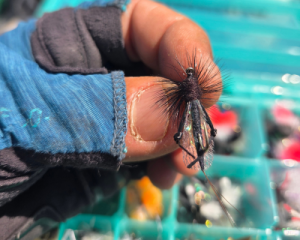
Something we’ve learned over the years: when anglers arrive with stacks of boxes, one of the first things we do is sit down together and edit them. The result is always the same — one or two boxes with the flies that actually work, no excess weight, no chaos. We love seeing each angler’s personal favorites, but quick access and a clear selection make a real difference on the water. When you can’t find the right fly fast, you simply don’t use it.
THE SECRET NO ONE WANTS TO HEAR
Confidence in your fly. The pattern matters — especially when trout are keyed in on something specific — but without confidence, even the perfect fly loses its edge. The most important skill is learning to read the conditions, making a good selection, and then committing to it and fishing. Observation is, and always will be, one of the true keys to success.
READY TO FISH?
If you want to come down and leave the “what flies do I bring?” question completely behind, get in touch. We offer all-inclusive programs — gear, flies, and guides who know exactly what’s working today, on this river, in these conditions.